Showing posts with label ibm. Show all posts

2/20/19

Week #8's Wednesday Evening Training: Quantum Computing, a practical introduction using IBM technology (part 4)

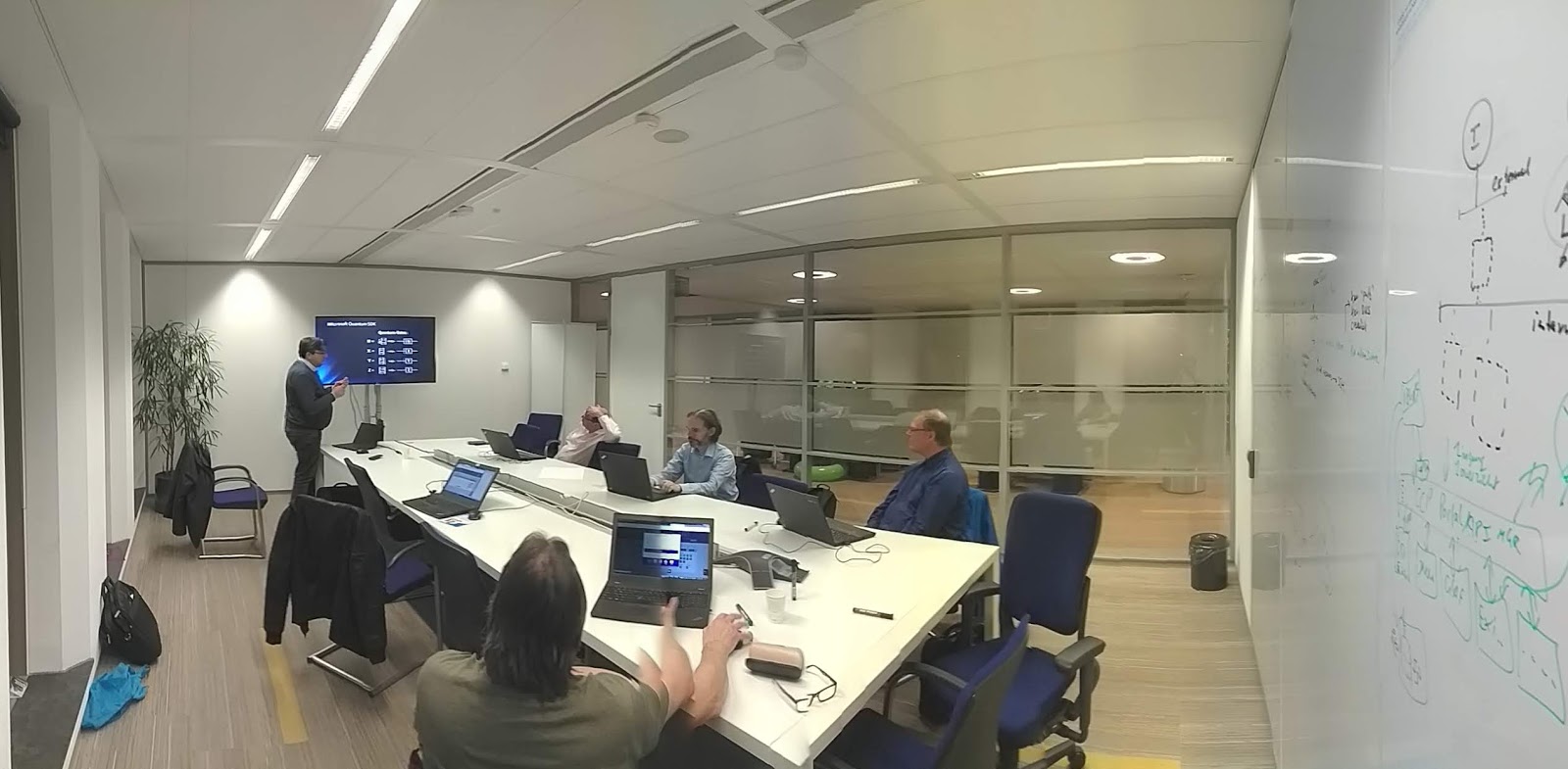
Continuing our exploration of Quantum Computing, guided by one of our Quantum Computer champions: Ilyas Sener. We had a little recap of Quantum logic gates, math topics and an inspiring brainstorm on topics for our upcoming Wednesday Evening Trainings on Quantum Computing.


Further reading

Do you want to read more on the topics in this post? Take a look at my post: "Quantum computing: an introduction and a lot of links to resources":
https://hansrontheweb.blogspot.com/2018/11/quantum-computing-introduction.html

Past Wednesday Evening Trainings on all topics

You 'll find post of previous sessions on my blog and on LinkedIn: https://www.linkedin.com/search/results/content/?keywords=%23wednesdayeveningtraining

Work @Capgemini?

Do you want to join us? We're always looking for and well-motivated young professionals. Do you have a bachelor or master degree or extensive practical experience? Or do you have a relevant ICT / Informatics training and you have become curious about us? Please send me an email. Working for us gives you access to all Wednesday Evening Trainings!

1/19/19

Week #3's Wednesday Evening Training: Quantum Computing, continuing with IBM technology

Our fourth Wednesday Evening Training on Quantum computing already! For the other sessions, see https://hansrontheweb.blogspot.com/search?q=quantum, for a quick catch-up on Quantum Computing, see: https://hansrontheweb.blogspot.com/2018/11/quantum-computing-introduction.html.


This week, we continued our labs and explored the various quantum logic gates that can be used in programming a Quantum Computer. Gates form the building blocks of quantum circuits, like classical logic gates do in digital circuits. They operate on a small number of qubits. So a Quantum "program" (actually called a "circuit") is a sequence of quantum gates.

Our Quantum Computer champions, Julian van Velzen and Ilyas Sener, gave us a lot of explanation, examples and help to get up to speed. We used IBM's Q Experience (see the resources below) for our labs.

There is still a lot to learn and experiment. We decided to plan a Wednesday Evening Training on Quantum Computing each month this year, so don't miss our updates!


Further reading

Do you want to read more on the topics in this post? Here are some links…

A very very very short introduction on Quantum computers: https://hansrontheweb.blogspot.com/2018/11/quantum-computing-introduction.html

On the basics of quantum physics:
Quantum Computing Expert Explains One Concept in 5 Levels of Difficulty (an excellent way to start!): https://www.youtube.com/watch?v=OWJCfOvochA
My YouTube list on Quantum Computing: https://www.youtube.com/playlist?list=PLSiMhBs48YvWecXqKP00NGuiP5UD6RoCk
How it Works: Quantum Computing: https://www.youtube.com/watch?v=WVv5OAR4Nik
Qubit (the basic unit of quantum information): https://en.wikipedia.org/wiki/Qubit
Quantum information (information that is held in the state of a quantum system): https://en.wikipedia.org/wiki/Quantum_information
Quantum system: https://en.wikipedia.org/wiki/Quantum_system
Quantum mechanics: https://en.wikipedia.org/wiki/Quantum_mechanics
Quantum Computing Primer: https://www.dwavesys.com/tutorials/background-reading-series/quantum-computing-primer
Quantum Computing basics: What is Quantum Computing?: https://www.microsoft.com/en-us/quantum/what-is-quantum-computing
Quantum Computing Technology: https://www.microsoft.com/en-us/quantum/technology

On the basics of the underlying math:
The Mathematics of Quantum Computers | Infinite Series: https://www.youtube.com/watch?v=IrbJYsep45E
Automata theory: https://en.wikipedia.org/wiki/Automata_theory
Turing machine: https://en.wikipedia.org/wiki/Turing_machine
Computational complexity theory: https://en.wikipedia.org/wiki/Computational_complexity_theory
Theory of computation | Computable and non-computable problems: https://www.geeksforgeeks.org/theory-of-computation-computable-and-non-computable-problems/

On quantum computer hardware:
IBM Q initiative to build commercially available universal quantum computers: https://www.research.ibm.com/ibm-q
Introduction to the D-Wave Quantum Hardware: https://www.dwavesys.com/tutorials/background-reading-series/introduction-d-wave-quantum-hardware

On Quantum computer software development:
Software Architecture & environment: https://www.dwavesys.com/software
Qiskit (an open-source quantum computing framework for leveraging today's quantum processors in research, education, and business): https://qiskit.org/
What is Qconfig in QISKit and how do I set it up?https://quantumcomputing.stackexchange.com/questions/2062/what-is-qconfig-in-qiskit-and-how-do-i-set-it-up
Quantum information: https://en.wikipedia.org/wiki/Quantum_information
Quantum computing: https://en.wikipedia.org/wiki/Quantum_computing
Quantum circuit: https://en.wikipedia.org/wiki/Quantum_circuit
Quantum logic gates: https://en.wikipedia.org/wiki/Quantum_logic_gate
Quantum circuit: https://en.wikipedia.org/wiki/Quantum_circuit
Qubit: https://en.wikipedia.org/wiki/Qubit
Microsoft Quantum Development Kit: https://www.microsoft.com/en-us/quantum/development-kit and https://docs.microsoft.com/en-us/quantum/?view=qsharp-preview
The Q# Programming Language: https://docs.microsoft.com/en-us/quantum/quantum-qr-intro?view=qsharp-preview
Download Quantum Studio: http://quantum-studio.net/#download_qs

On quantum computer simulators:
IBM: https://quantumexperience.ng.bluemix.net/qx/editor
The QX Simulator: http://quantum-studio.net
Ready-to-use Linux Ubuntu Virtual Machine with QX installed: http://quantum-studio.net/#download_vm
Quantum Computing Playground: http://www.quantumplayground.net
QCEngine - active QC simulator: http://machinelevel.com/qc/
List of Quantum computer simulators: https://quantiki.org/wiki/list-qc-simulators
Another list of Quantum computer simulators: http://www.vcpc.univie.ac.at/~ian/hotlist/qc/simulation.shtml
Quantum computer simulator: https://qcsimulator.github.io/

Other resources:
Microsoft's Quantum Computing portal: https://www.microsoft.com/en-us/quantum
Microsoft's Quantum Computing, technologies (Physics, Materials, Devices, Control, Runtime): https://www.microsoft.com/en-us/quantum/technology
IBM Q Experience! Guides, demo's etc.: https://quantumexperience.ng.bluemix.net/qx/experience
Microsoft Quantum: https://www.microsoft.com/en-us/quantum
Microsoft Research on Quantum Computing: https://www.microsoft.com/en-us/research/lab/quantum/
Hello Quantum - Explore the building blocks of quantum mechanics through puzzles: http://helloquantum.mybluemix.net

Past Wednesday Evening Trainings on all topics

You 'll find post of previous sessions here: https://www.linkedin.com/search/results/content/?keywords=%23wednesdayeveningtraining


#quantumcomputers #quantumcomputing #wednesdayeveningtraining #werkenbijcapgemini #lifeatcapgemini #capgemini #hansrontheweb #qiskit #ibm

11/14/18

Week #44's Wednesday Evening Training: Hands-on with Quantum Computing, a practical introduction using Qiskit (part 1)

A very very very short introduction on Quantum computers

As progress on processing speed and miniaturization continues, we stuble on the phycical limits of modern binary digital electronic computers based on transistors. Using quantum physics, however, we can increase processing speed drastically. In digital computing data is encoded into binary digits (bits), each of which is always in one of two definite states (0 or 1). A quantum computer works with particles that can be in superposition. Quantum computers use Quantum Bits or Qubits, which can take on the value 0, or 1, or both simultaneously. This drastically speeds up processing. This, however, also poses some challenges... and limitations.

More on these challenges and limitations on Quantum computers in my blogpost: https://hansrontheweb.blogspot.com/2018/11/quantum-computing-introduction.html


Back to our Wednesday Evening Training on Quantum computing

This was actually our second Wednesday Evening Training on Quantum computing (for the first session, see my blogpost: https://hansrontheweb.blogspot.com/2018/08/this-weeks-wednesday-evening-training_30.html). This evening, two of our Quantum Computer champions, Julian van Velzen and Ilyas Sener, gave us a quick theoretical background and covered basic concepts such as superposition and entanglement. Julian gave us some nice demo's of Quantum computer algorithms and a code walkthrough of a Python implemented quantum algorithm to solve the Bernstein-Vazirani parity problem, without entanglement and run on real IBM Q Bluemix [ibmqx4] machine!


But there is no sitting down in the Wednesday Evening Training, using the basic conceptual understanding of Quantum computing, we started  programming ourselves using the IBM Qiskit. This is an open-source quantum computing framework for leveraging today's quantum processors in research, education, and business (see the links to resources below). At the end of the evening, we ran our first “hello world” quantum algorithm.

Interesting and game changing technology!

In the next Wednesday Evening Training session on Quantum computing, we will continue learning to develop by covering different basic quantum algorithms. Lot's of great stuff to be explored!


Further reading

Do you want to read more on the topics in this post? Here are some links…

On the basics of quantum physics:
My YouTube list on Quantum Computing: https://www.youtube.com/playlist?list=PLSiMhBs48YvWecXqKP00NGuiP5UD6RoCk

Past Wednesday Evening Trainings


You 'll find post of previous sessions here: https://www.linkedin.com/search/results/content/?keywords=%23wednesdayeveningtraining

#wednesdayeveningtraining #capgemini #lifeatcapgemini #quantumcomputing #qiskit